Friday, 29 January 2010
Prep w/c 1st Feb '10

Practice Exercise 1 p. 320, Q 4-9
Extension work: Look up the Nationwide Consumer Confidence (http://www.nationwide.co.uk/NR/rdonlyres/598E66D7-3FBE-4082-89D2-ADAB346926E4/0/DecemberNCCI_6Jan09.pdf)
and comment on the implications for UK businesses.

Tuesday, 26 January 2010
Saturday, 12 December 2009
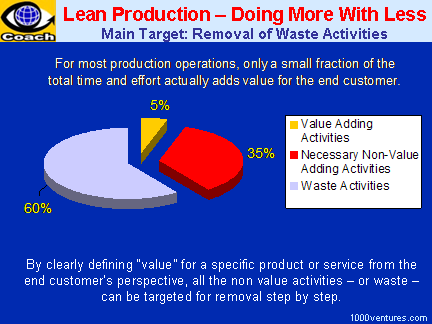
Lean production - doing more with less
http://www.1000ventures.com/business_guide/lean_production_main.html
youtube video on lean production:
http://www.youtube.com/watch?v=4GcJBgQ71TM&feature=related
youtube video on Kaizen:
http://www.youtube.com/watch?v=Q89qAbAAR3Q&feature=related
Another useful site which looks at the history of lean production:
http://www.strategosinc.com/just_in_time.htm
Kanban:
http://www.thetimes100.co.uk/theory/theory--lean-production--252.php
Thursday, 3 December 2009
Prep to be completed for Monday 7th Dec
Complete Thames Water case study p.290/1 preliminary questions 1-5
Monday, 16 November 2009
Saturday, 14 November 2009
The organisational costs of workplace conflict
(From the ACAS website)Workplace conflict – the organisational costs:
• the risk of time-consuming formal proceedings such as grievances and employment tribunal claims
• sickness absence costs as the individuals concerned take time off to deal personally with the effects of the conflict
• management time being diverted to dealing with the conflict instead of focusing on managing the business
• staff turnover and recruitment and re-training costs where conflict leads to the departure of those affected from the organisation
• lower staff morale leading to less commitment to exerting discretionary effort, leading to lower productivity
• poor working relationships within the teams affected
• loss of focus on corporate goals and common objectives as people are distracted by the disagreement
• the potential for a blame culture to develop, rather than one focused on innovation
• the employer’s external reputation could be compromised
Mediation
• the risk of time-consuming formal proceedings such as grievances and employment tribunal claims
• sickness absence costs as the individuals concerned take time off to deal personally with the effects of the conflict
• management time being diverted to dealing with the conflict instead of focusing on managing the business
• staff turnover and recruitment and re-training costs where conflict leads to the departure of those affected from the organisation
• lower staff morale leading to less commitment to exerting discretionary effort, leading to lower productivity
• poor working relationships within the teams affected
• loss of focus on corporate goals and common objectives as people are distracted by the disagreement
• the potential for a blame culture to develop, rather than one focused on innovation
• the employer’s external reputation could be compromised
Mediation
Subscribe to:
Posts (Atom)